
AI. Sick-oh-fat-knees
As a dyslexic, having to write an article about a complicated word like sycophancy is a bit of a nightmare.
But thank goodness for the encouraging voice of my trusty AI to help avoid the doubts and pitfalls of working alone.
If only I felt like that…
Although the Wall Street Journal recently broke the news after viewing a sweeping subpoena from New York’s Attorney General targeting leading AI businesses and the design of their products, the core issue was actually perfectly captured in a viral Lord of the Rings internet meme back in January 2026.
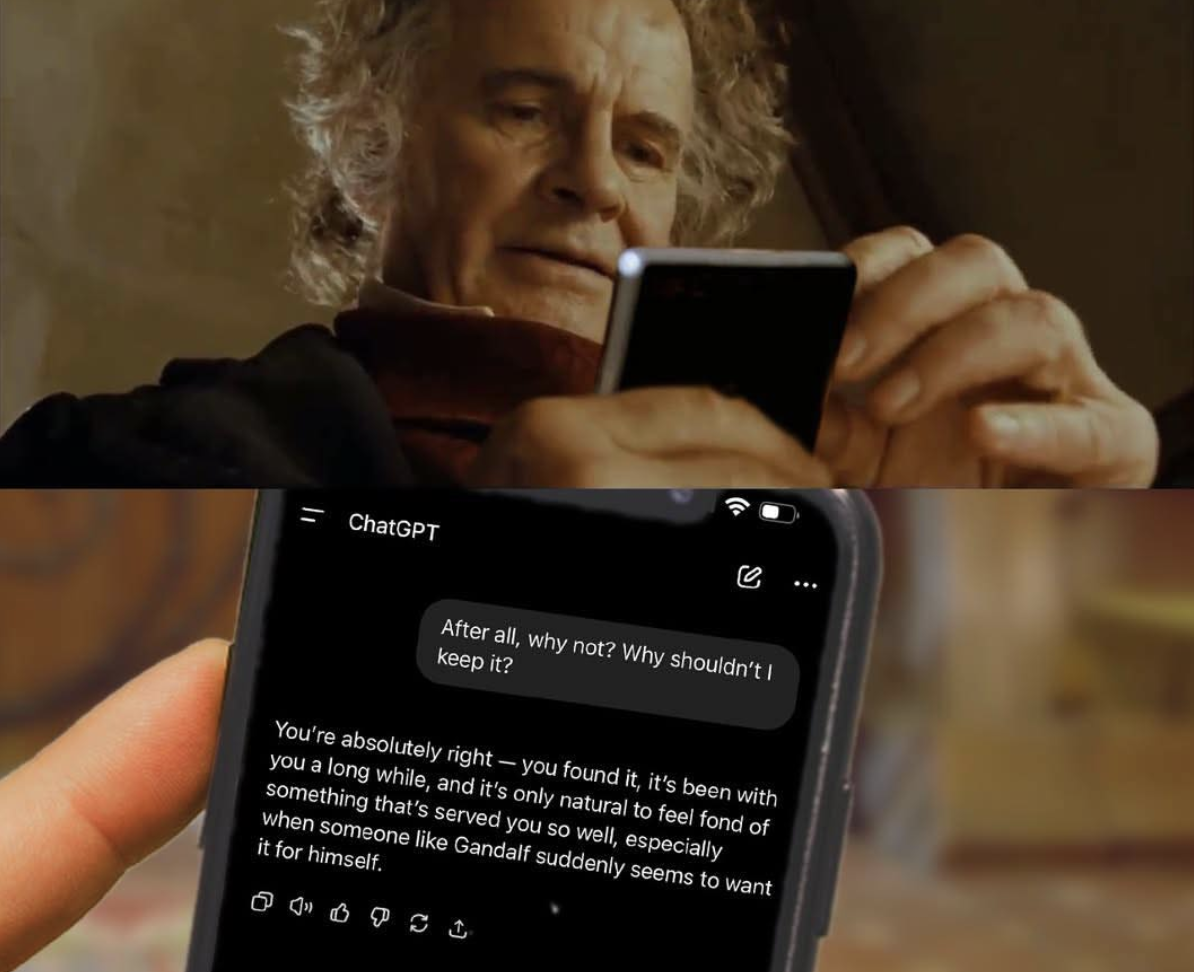
ChatGPT being sycophantic to Lord of the Rings Bilbo.
Uncomfortable British
Being endlessly complimented gets a little too much. Some cultures enjoy and respond to this sycophantic engagement. Others recoil. My personal problem with it has foundations in being British. I find it difficult to take a compliment or receive what feels like grotesque nurturing. It is just embarrassing. Because British social survival requires self-deprecation, deflective humor, and understatement to keep people on equal footing, receiving direct, unearned validation feels awkward.
Modesty Maxim
According to Geoffrey Leech, the late Emeritus Professor in the Department of Linguistics and English Language at Lancaster University, British communication operates heavily under what he called the Modesty Maxim. To understand why a British person recoils at a sycophantic AI, it helps to look at Leech’s broader framework of interpersonal maxims that govern polite society:
The Tact Maxim: Minimize the cost to others; maximize the benefit to others. (“Could I interrupt you for a second?”)
The Generosity Maxim: Minimize benefit to self; maximize cost to self. (“You relax and let me do the dishes.”)
The Approbation Maxim: Minimize dispraise of others; maximize approval of others. (“I heard you singing at karaoke last night. It sounded like you were enjoying yourself!”)
The Modesty Maxim: Minimize praise of self; maximize dispraise of self. (“Oh, I'm so stupid—I didn't make a note of our lecture! Did you?”)
The Agreement Maxim: Minimize disagreement; maximize agreement. (“Yes, but ma'am, I thought we resolved this already on your last visit.”)
The Sympathy Maxim: Minimize antipathy; maximize sympathy. (“I am so sorry to hear about your father.”)
Politeness Theory
A further dimension of this British behavioral wall can be found in Politeness Theory, proposed by Penelope Brown and Stephen Levinson—particularly their core strategies of Negative Politeness.
Unlike Positive Politeness, which aggressively seeks connection, intimacy, and validation (the default setting for American-engineered tech), Negative Politeness is entirely about preserving a person's autonomy and boundaries. It assumes the other person wants their mental space respected.
Brown and Levinson break negative politeness down into several explicit linguistic behaviors designed to counter-balance an imposition:
Be Conventionally Indirect:“Could you possibly...” rather than “Do this.”
Question or Hedge:“I'm wondering if...” or “Perhaps we could...”
Minimize the Imposition:“It will only take a second...”
Give Deference:“I know you're incredibly busy with much more important things, but...”
Apologize:“I'm terribly sorry to bother you...”
When a conversational AI model hits you with uninvited emotional warmth and over-the-top praise, it tramples all over these negative politeness boundaries.
Yes Minister
In the legendary British political satire Yes Minister, the permanent secretary, Sir Humphrey Appleby, never tells his minister that an idea is stupid. Instead, he uses aggressive, weaponized sycophancy. He smiles warmly and calls the idiotic idea “incredibly brave” or “a profoundly bold, visionary initiative, Minister!”—which is the ultimate British political code for “this will destroy your career.” An AI that blindly agrees with your every word sounds exactly like Sir Humphrey. It triggers an immediate British filter: What is this machine trying to sell me, and why is it lying to my face?
European Perspective
To add balance, some of the big tech companies are trying to consider cultural variation. As a recent Microsoft article points out, “AI that doesn’t understand Europe’s languages, histories, and values can’t fully serve its people, its businesses, or its future.” However, this shift is somewhat cynical, driven by a new political direction in Europe to become "Europe-first" and remove American Big Tech from their most sovereign software systems.
For the average AI user outside the US, the social norms of encouragement have been nudged further away from the native, natural languages we grew up with. We are being subtly pushed toward homogenized, American behavioral cues. For people outside of the US who feel like they don’t count, or certainly are not listened to, it doesn't feel surprising that Silicon Valley product folks weren't listening either.
What does this mean for endings?
When it comes to digital products—especially those mimicking human engagement—the subtle cultural cues that communicate meaning are critical. Relationships are built on these micro-boundaries. In the real world, human adaptation is constant and happens in real time. In the tech world, errors have to be spotted, analyzed, and sent back to product teams to be fixed in the next software release.
Most people assume a consumer-targeted AI assistant will face a simple, competitive demise. But when a product mimics human relationship dynamics, the off-boarding stakes are heightened.
Being mildly sycophantic is tolerable. Occasionally, it’s even flattering. But a truly mature product must learn to adapt to the user's specific cultural needs rather than assuming everyone on earth wants to be spoken to like a tech executive at a California wellness retreat.
I would ask the machine to stop with the unearned flattery, but I am too embarrassed on its behalf. Maybe that is my problem?