

Why is Product Off-boarding the Most Important Part of the Customer Journey?
Businesses focus 99% of their budget on onboarding, yet the ending—or product off-boarding—is what defines brand loyalty, sustainability ROI, and legal compliance. By 'Endineering' a clear conclusion, companies eliminate 'bad churn,' protect brand equity, and close the circular economy loop.
Why end?
How does neglecting product endings create business risk?
Businesses gather extensive data on customers during onboarding and usage, tracking desire and product engagement. But at the end? Hardly any data is captured, leaving businesses in the dark. Ignoring this stage is a business risk—endings are part of your business.
> Read my full deep-dive on Consumer-Centric EPR and Legislative Risk.
Tetrapak 190 Billion packages yearly.
Also say EOL is too hard to calculate.
Scope 3 puts legal expectations on businesses. Tetrapak pride themselves on their environmental approach yet say “The end-of-life treatment varies from case to case depending on local recycling conditions as well as the choices made by the end consumer. To calculate the exact footprint of each of these combinations would be a very lengthy task.” Tetrapak bases its assumptions on European averages - 47% recycling and 29% energy recovery, and landfill 24%. (Tetrapak)
Ignoring the end of the customer journey creates a "data dark spot" that exposes your business to massive financial and regulatory liabilities.
Key Takeaway: How to manage Scope 3 emissions and ESG mandates through Endineering.
Can designing a better cancellation experience increase customer satisfaction?
Businesses that engage at the end boost consumer satisfaction.
Netflix exemplifies this with its flexible, easy-to-cancel contracts, unlike US cable companies, which impose year-long contracts with penalties. Netflix’s consumer satisfaction is in the mid-80s and rising, while US cable companies are in the mid-60s and have been declining for 11 years.
The difference is the end. Some businesses design for it and make it appear clear and comfortable.
Others avoid it.
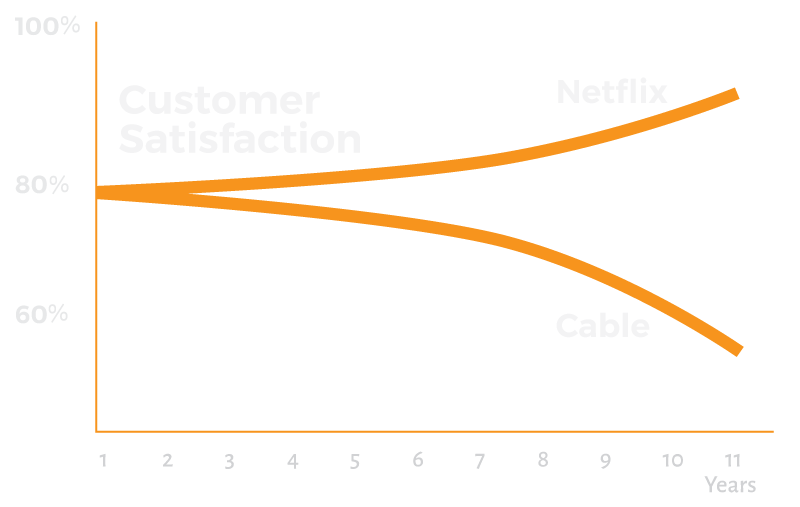
Netflix proves that making it "clear and comfortable" to leave actually increases long-term loyalty compared to traditional exit tactics.
Key Takeaway: Why a transparent off-boarding process leads to higher customer retention.
Why is consumer off-boarding essential for the Circular Economy?
Many proposed solutions to overconsumption focus on technical or efficiency improvements, often requiring new purchases of “more sustainable” products, or putting a certification symbol where a consumer experience should be.
We should design consumer off-boarding experiences that bond provider and consumer together in mutual purpose to neutralise the negative consequences of consumption.
> Explore the methodology in Measuring Circularity and Product Endings.
Business spend $480,000 on ESG certification.
Also, consumers baffled by the 450 ESG symbols in the world.
*Publicly-listed companies spend $220,000 to $480,000 annually on ratings (Reuters), often leading to certificates and marketing symbols. Consumers struggle to understand the many environmental labels. There are 200 labels in the EU and over 450 worldwide (EU).
True circularity fails when we focus only on materials; we must design the human experience that guides a consumer to actually close the loop.
Key Takeaway: Moving beyond 450+ confusing symbols to an "Endineered" recovery path.
What are the legal requirements for product endings in GDPR and ESG?
In the past decade, new laws have emerged focused on the end of the consumer lifecycle. From GDPR and the California Consumer Privacy Act in digital sectors to Scope 3 Greenhouse Gas Emissions in manufacturing and the Energy Switch Guarantee in services, these regulations have added complexity to product endings, often poorly communicated to consumers.
Clarifying these endings could enhance legal compliance, consumer perception, and overall product experience.
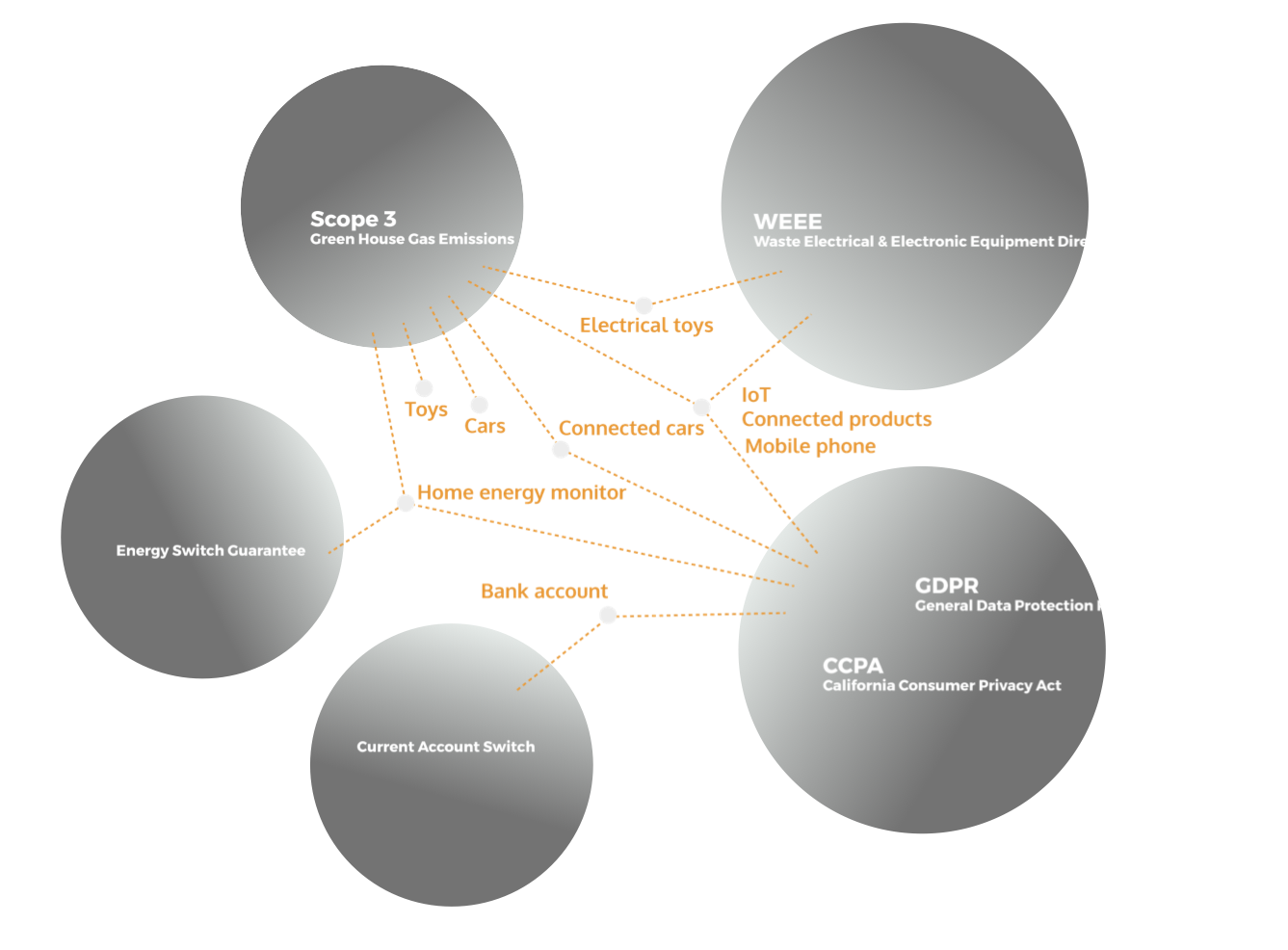
From GDPR to new Greenhouse Gas mandates, businesses are now legally responsible for the "invisible" end of their product's life.
Key Takeaway: How to turn mandatory compliance into a helpful, branded customer touchpoint.
How does endineering drive business innovation in Customer Experience (CX)?
Businesses aspire to be innovative, yet throw enormous amounts of money in to well trodden areas Customer Experience (onboarding and usage) for marginal improvements.
The end of the consumer lifecycle is a wide open landscape with enormous opportunities, little competition, and the potential to create new areas of innovation. Customers are desperate for improvement.
80% of companies plan to increase their level of investment in CX. *
Yet there’s “marked rise” of bad endings.**
*(Zendesk 2024)
**The National Law Review reported a “marked rise” in dark patterns, including Roach Motel tactics (never leave), in late 2023. A Dovetail survey found over 40% of consumers faced unplanned financial consequences due to this.
While competitors fight for tiny gains in onboarding, the "End-of-Life" phase is a wide-open Blue Ocean for brand differentiation.
Key Takeaway: Identifying the "Innovation Gap" where zero competition currently exists.
Does a clear product ending increase business sales?
People often say, "with every good end, starts a beginning".
This misses the point.
Businesses excel at beginnings but overlook how endings impact sales. As Daniel Pink notes, customers feel reassured by a clear exit.
Kia Cars 7-year warranty provided an ending to the product. Customers loved it so much it doubled global sales.
Learn more about the ROI of Sustainability and Consumer Connection.
Kia introduce 7 year warranty (ending)
Kia sales increase 200% globally.
Behavioral science shows that providing a clear "off-ramp" at the beginning removes the fear of commitment and triggers the next purchase.
Key Takeaway: The Kia Case Study: How a 7-year warranty doubled global sales.
How do bad product endings destroy brand equity?
Brands lose lots when a customer leaves. Not just the revenue of a loyal customer, but, arguably more important, the brand equity. Gargantuan effort, resources, and money at the beginning is lost at the end. Ask any consumer, who found it a difficult to leave, what they think of that brand after departure and you will always hear their promise of ‘never again’.
Business need to protect their brand, and the memories of a good experience at the end.

A single bad ending triggers the "Never Again" effect, where a difficult exit erodes years of positive brand building in minutes.
Key Takeaway: Using the Peak-End Rule to protect your brand’s legacy and future "re-boarding."