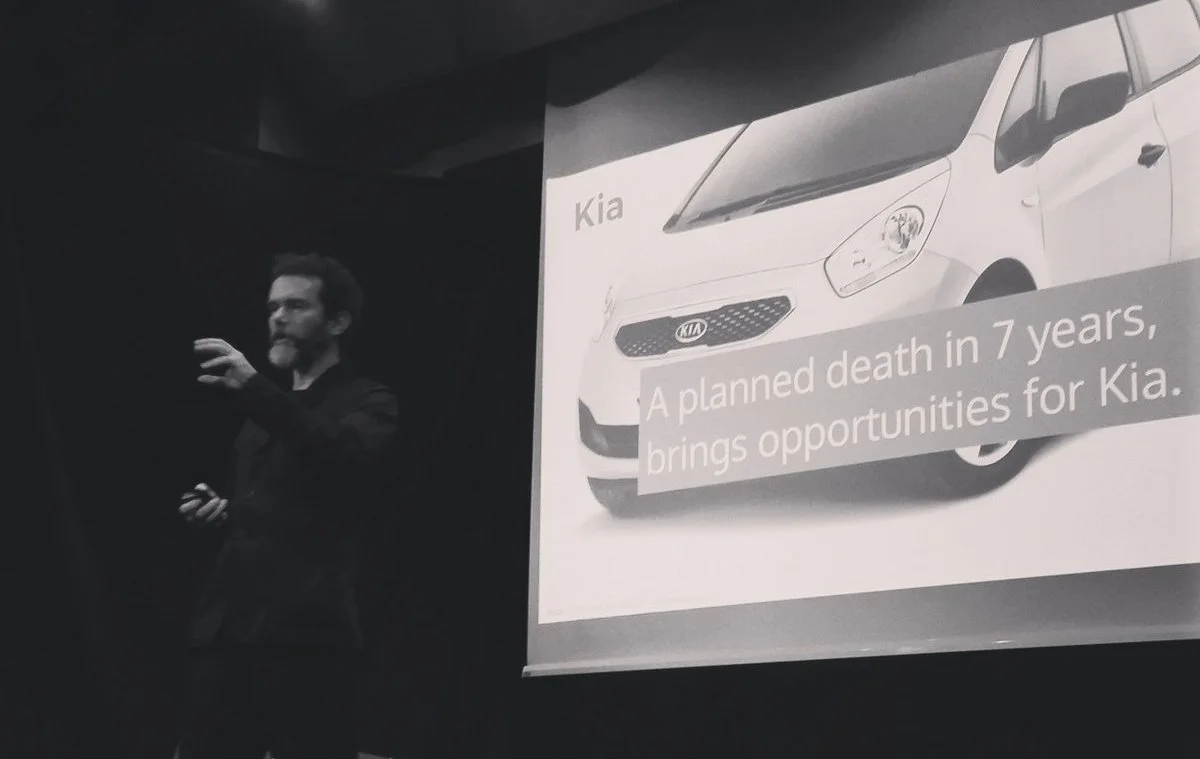
The 8 Ending Types in Product Design: An Automotive Lifecycle Study
The Ending Types Model defines the eight primary drivers of customer off-boarding. While most businesses only focus on competitive churn, this framework identifies how biological shifts, regulatory mandates, and social trends dictate the real-world conclusion of every product or service relationship.
What are Ending Types?
In the Endineering framework, Ending Types are categories that define why and how a product or service concludes its relationship with a consumer. While businesses often focus only on "Competitor" churn , this model identifies eight distinct drivers—from biological shifts to regulatory mandates—that dictate the real-world end of a customer lifecycle.
How will your relationship with your car come to an end?
Surprisingly, it's not always because the car breaks down! People experience car endings in all kinds of ways that go far beyond the traditional idea of a car wearing out. What’s interesting is how little these endings actually have to do with the car’s condition. Instead, they reflect broader societal trends, personal circumstances, and even new regulations. Let's explore eight common ways consumers say goodbye to their cars and what they reveal about the future of car design.
Time Out Ending
[The Fixed-Duration Ending]
The product or service is delivered over a pre-defined period. Once the clock stops, the relationship ends. This includes everything from a three-year university degree to a 24-hour digital film rental.
The Automotive Case: Aging demographics where the driver's safe-operating "window" expires.
As populations around the world age, an increasingly common reason for letting go of a car is simply the inability to drive safely anymore. Although unsafe drivers can be any age, data shows that both young and elderly drivers are at greater risk of accidents. For instance, traffic fatalities for drivers aged 15 to 20 in the U.S. rose by nearly 10% between 2020 and 2021, accounting for over 5,500 deaths. Among drivers aged 65 and older, fatalities increased by 15%, representing more than 8,200 deaths. In fact, drivers over the age of 80 have one of the highest rates of accidents per mile driven. As people age, their ability to drive safely diminishes, and eventually, they face a choice: give up driving or risk becoming a danger on the road.
This type of ending isn’t about the car falling apart—it’s about the driver. The car itself might be perfectly fine, but when it’s time for the driver to hang up the keys, it’s often the end of the road for both the car and its owner.
Credit Out / Exhaustion
[The Value-Depletion Ending]
The relationship ends when a specific numeric value or resource is used up.
Covers everything from a phone data plan and discharged batteries to a medical insurance limit.
The Automotive Case: The 2035 Zero-Emission mandates, which act as a regulatory "expiration date" for fossil-fueled cars.
As societies tackle climate change, new regulations are emerging that will eventually force many of us to say goodbye to our fossil-fueled cars. For example, the European Union has set a target that all new cars sold by 2035 must be zero-emission. This doesn’t mean that all existing cars will have to be scrapped, but it does set a clear expiration date for gas-powered vehicles. Jan Huitema, a Dutch MEP and drafter of the EU's CO2 legislation, explained that while current cars can continue to be used until the end of their lifespan, by 2035, new purchases must be CO2-neutral to help the EU meet its climate goals by 2050.
For many consumers, this means the countdown has already started. Whether due to financial incentives or regulations, the push toward electric vehicles (EVs) will drive many fossil-fueled cars off the road. For the eco-conscious, it’s less about the car breaking down and more about phasing out a mode of transportation that no longer fits in a greener world.
Task/Event Completion
[The Objective-Driven Ending]
The service or product exists to fulfill a specific, agreed-upon goal. Once the goal is met, the engagement is done. Examples range from a successful plumbing repair to completing a level in a video game.
The Automotive Case: Shifts in life events, like moving to a city center where a commute is no longer required.
One of the most common reasons for using a car is to commute to work. In the UK, for example, about 16% of all journeys are related to getting to work. However, life changes—like switching jobs or moving—can prompt people to reconsider how they get around. If the new job is closer to home, a person might take up cycling or walking. Alternatively, if the new job is in a city center where parking is a hassle, public transportation may become more attractive.
In these situations, the car might not be needed as often, and as it sits idle in the driveway, its owner may decide it’s time to let go. While the car itself isn’t broken, its role in the owner’s life is complete, and it no longer serves a purpose.
Cultural Ending
[The Social Alignment Ending]
The relationship ends because the product is no longer perceived as culturally or socially acceptable.
Impacted by shifting trends in fashion, social media ethics, or corporate reputation.
The Automotive Case: The urban backlash against SUVs ("Chelsea Tractors") or the political polarization of certain EV brands.
Societal opinions can also hasten the end of a car’s life. Consider the backlash against SUVs in urban areas, particularly in London, where they’ve earned the nickname "Chelsea Tractors." Research shows that three-quarters of the 360,000 SUVs sold in the UK in 2019 were bought by people living in cities, where their large size is often impractical. Criticism of SUV owners for their environmental impact has become common, prompting some to sell their vehicles to avoid being part of the controversy.
Even the once-heroic Tesla has faced this issue. While the car itself hasn’t changed, the public image of Elon Musk has caused embarrassment for some Tesla owners. Many have expressed discomfort with the idea that owning a Tesla might suggest they support Musk’s politics, leading to some putting bumper stickers on their cars to distance themselves from his views.
Broken / Withdrawn
[The Premature Separation Ending]
An unplanned, uncomfortable end caused by failure or the provider pulling out. Seen in product breakage, corporate bankruptcy, or the withdrawal of software support.
The Automotive Case: Orphaned vehicles left without support after a manufacturer (like Fisker) goes bust.
Sometimes, our expectations for a car don’t align with reality. The Fisker electric vehicle (EV) brand is a great example of this kind of disappointment. When Fisker first launched, it aimed to compete with Tesla, selling its cars directly to consumers. However, after ballooning costs and production issues, the company went bankrupt, leaving at least 6,400 Fisker owners stranded with problematic vehicles. From faulty key fobs to connectivity blackouts, Fisker’s owners had to deal with numerous mechanical issues, with no company support to help them.
For some consumers, the car of their dreams turns into a nightmare. When the company that made the car disappears, it can be difficult or even impossible to maintain the vehicle, forcing owners to part ways earlier than expected.
Lingering Ending
The Automotive Case: Vehicles abandoned in impound lots due to financial barriers or lack of disposal instructions.
Sometimes, the end of a car’s life isn’t due to wear and tear but financial hardship. In the U.S., about 55,000 vehicles are towed daily, often because their owners can’t afford to retrieve them after a breakdown or parking violation. Cars stuck in impound lots become relics of financial struggle, as people lose their vehicles due to unpaid fines or repair costs. In the UK, the number of impounded cars has risen sharply, with an estimated 197,000 vehicles towed in 2023. Rising insurance costs mean some drivers are forced to risk driving uninsured, further increasing the likelihood of losing their cars.
Competition Ending
[The Residue Ending]
The active relationship is over, but the physical or digital assets remain in the user's environment. Includes unused apps capturing data, old clothes in cupboards, and e-waste in drawers.
The Automotive Case: Vehicles abandoned in impound lots due to financial barriers or lack of disposal instructions.
As cities evolve, the competition between cars and alternative modes of transport grows. In Paris, for example, bicycles have surpassed cars in popularity for inner-city travel, with 11.2% of trips now made by bike compared to just 4.3% by car. The trend started during a transit strike in 2019 and accelerated during the COVID-19 pandemic, as people realised the convenience and cost-effectiveness of cycling. With cities prioritising bikes, public transport, and pedestrian spaces, many people may find their cars sidelined by newer, greener options.
Proximity Endings
The Automotive Case: Parking has become a near-constant headache for drivers.
While many employers alleviate this stress by providing staff parking, the struggle remains real at home. Everyone knows the frustration of circling the block for 20 minutes just to find a single open spot. If parking isn't immediate, the convenience of owning a vehicle vanishes, leaving the driver with nothing but a sense of burden and irritation.
Experience endings need designing
Each of these endings reveals something different about how our relationship with cars goes beyond the physical demise and often ends as a result of something else. Whether driven by safety concerns, environmental goals, financial pressures, or simply societal shifts, the way we get closure should be considered when engaging with car design. Many businesses look at their product ending through the lens of material matter. It is often more an issue of life events.
Get in touch for help with your product off boarding experiences.